
Home » Discover the CHERI security technology » Rust and CHERI
Since both Rust and CHERI tackle memory safety issues, it might be confusing and people might think that the two technologies compete… they are not, and here is why.

Rust reduces bugs at the source; CHERI limits the blast radius when bugs exist and prevents supply-chain attacks.
Writing new code in Rust is desirable because it helps to minimize mistakes during development. However, it is impossible to rewrite all legacy code, economically (opportunity cost, risk of introducing new issues) and practically (Rust requires “unsafe” FFI code)… CHERI can protect existing code, including libraries that Rust assumes to be OK. CHERI is a better platform to run Rust programs!
So we need the two, and this is why we have a Rust+CHERI working group!
Even developers taking great care in developing code usually only write a very small part of the end application. Most code comes from operating systems, libraries and drivers developed by third parties, sourced from open-source repositories, or increasingly generated using AI-assisted tools.
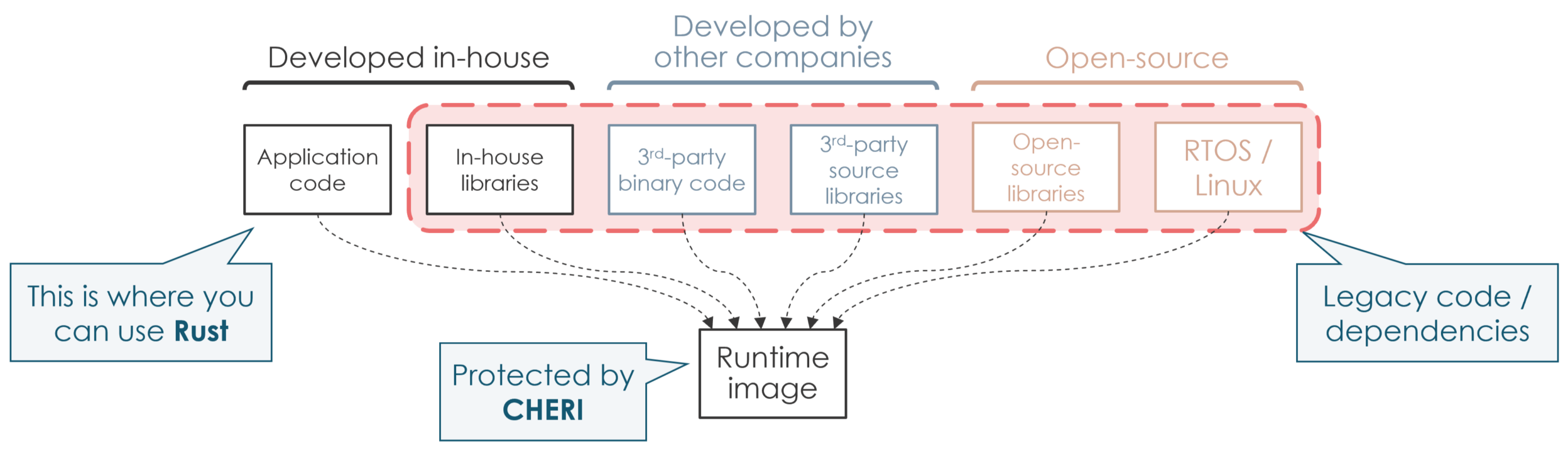
As we see a surge in software supply chain attacks, with repositories being compromised through malicious contributions, it becomes increasingly difficult to blindly trust these elements. CHERI helps protect your system by isolating various elements in compartments, and operating systems can even be optimised for CHERI. This is the work we do in the related working groups (Linux, FreeRTOS, Zephyr, seL4…) but also that commercial vendors do, e.g. VxWorks by Wind River.
In particular, CHERIoT builds on CHERI with a rich compartmentalisation model that makes least-privilege isolation practical for embedded and IoT software.
The table below shows that Rust and CHERI are complementary, not competitors.
Takeaway: use Rust to prevent the most common memory-safety bugs in new code (by design, at compile time), and use CHERI to enforce strong, hardware-backed bounds and isolation at runtime — including across unsafe Rust, FFI calls, and legacy C/C++ dependencies. In practice, the strongest systems combine both.
Legend: ● Covered, ○ Partial, (blank) Not covered
| PROPERTY | RUST | CHERI | RUST + CHERI | NOTES |
|---|---|---|---|---|
| SPATIAL MEMORY SAFETY | ||||
| Buffer overflow prevention | ○ | ● | ● | Only in safe Rust, via bounds checks on slices; CHERI via hardware capability bounds on every pointer |
| Out-of-bounds read | ○ | ● | ● | This is caught in safe Rust; CHERI also catches it in inline assembly and FFI code |
| Bounds on heap allocations | ○ | ● | ● | Rust checks bounds only in safe code; CHERI tags every allocation with hardware bounds regardless of language |
| Pointer integer confusion | ○ | ● | ● | CHERI capabilities cannot be forged from integers — hardware tag bit enforces this; Rust's type system allows raw pointer casts via unsafe |
| Pointer provenance enforcement | ○ | ● | ● | Safe Rust tracks provenance conceptually; CHERI enforces it in silicon — no capability without derivation from a valid source |
| TEMPORAL MEMORY SAFETY | ||||
| Use-after-free prevention | ● | ○ | ● | Rust's ownership model statically prevents this in safe code. CHERI provides use-after-free protection with capability revocation |
| Dangling pointer prevention | ● | ○ | ● | Rust's borrow checker statically prevents dangling pointers; CHERI requires revocation support for equivalent temporal safety |
| Double-free prevention | ● | ● | ● | Rust's ownership enforces single deallocation; Handled by CHERI memory allocator |
| Memory leak prevention | ○ | ○ | Rust reduces accidental memory leaks but does not eliminate them entirely. Still requires programmer’s care, or dedicated tooling | |
| TYPE AND VALUE SAFETY | ||||
| Type confusion (same-size structs) | ● | ● | Rust's type system distinguishes structs of the same size; CHERI only tracks bounds and provenance | |
| Data race prevention | ● | ○ | ● | Rust's Send/Sync traits enforce thread safety at compile time; CHERI has no concurrency model, but guarantees relaxed atomicity for all pointer loads and stores |
| Uninitialized reads & arithmetic errors | ● | ● | Rust requires initialization before use and panics on integer overflow in debug builds; Out of scope for CHERI | |
| ISOLATION AND COMPARTMENTALISATION | ||||
| Cross-component memory isolation | ● | ● | CHERI compartmentalisation enforces that objects in one compartment cannot be accessed by another. Rust has no equivalent at the process/component boundary | |
| C/C++ code cannot corrupt Rust objects | ● | ● | Without CHERI, a bug in linked C code can corrupt any Rust object in the same process. CHERI enforces bounds on all code in a compartment regardless of language | |
| Supply-chain isolation | ● | ● | CHERI provides tools to build compartments to isolate third-party or malicious library code | |
| Least-privilege enforcement | ● | ● | CHERI capabilities are monotonically non-increasing — a component can only delegate a subset of its own permissions | |
| COVERAGE AND SCOPE | ||||
| Protects unsafe Rust blocks | ● | ● | Even though tools can help, Rust waives its own guarantees in unsafe blocks. CHERI hardware checks apply regardless — this is the most critical complementarity | |
| Protects assembly / non-Rust code | ● | ● | CHERI hardware protects all code including inline assembly, OS kernels, and bootloaders that Rust cannot touch | |
| No compiler trust required | ● | ● | Rust's guarantees depend entirely on compiler correctness. CHERI enforces its properties in silicon — a buggy or malicious compiler cannot bypass hardware capabilities | |
| Reuse existing software | ● | ● | Rust requires a complete code re-write. CHERI requires recompilation and fixing a few issues (max 0.5% of lines of code) | |
| Works on existing hardware | ● | Rust requires only a compiler. CHERI requires hardware support | ||
| DEVELOPER EXPERIENCE AND ADOPTION | ||||
| Zero runtime overhead (safe code) | ● | ● | ● | Safe Rust has near-zero overhead. CHERI shows less than 3% overhead, but runtime protection enables further optimisations to significantly improve performance at the same security level |
| Protects legacy codebases without rewrite | ● | ○ | CHERI requires only a recompile of most C/C++ code. Rust requires a full rewrite — economically infeasible for the world's existing C/C++ codebase | |
| Capability sealing (object authority) | ● | ● | CHERI supports sealing capabilities so they can be held but not dereferenced except by the designated unsealer — enabling secure object references and cross-compartment handles | |
| Embedded / bare-metal systems support | ● | ● | ● | Both support embedded systems without an OS |
The bottom line: Rust secures the code you write; CHERI secures the memory environment that code runs in — including its dependencies, its unsafe blocks, and the legacy C code it inevitably touches. Opposing them is a category error.